
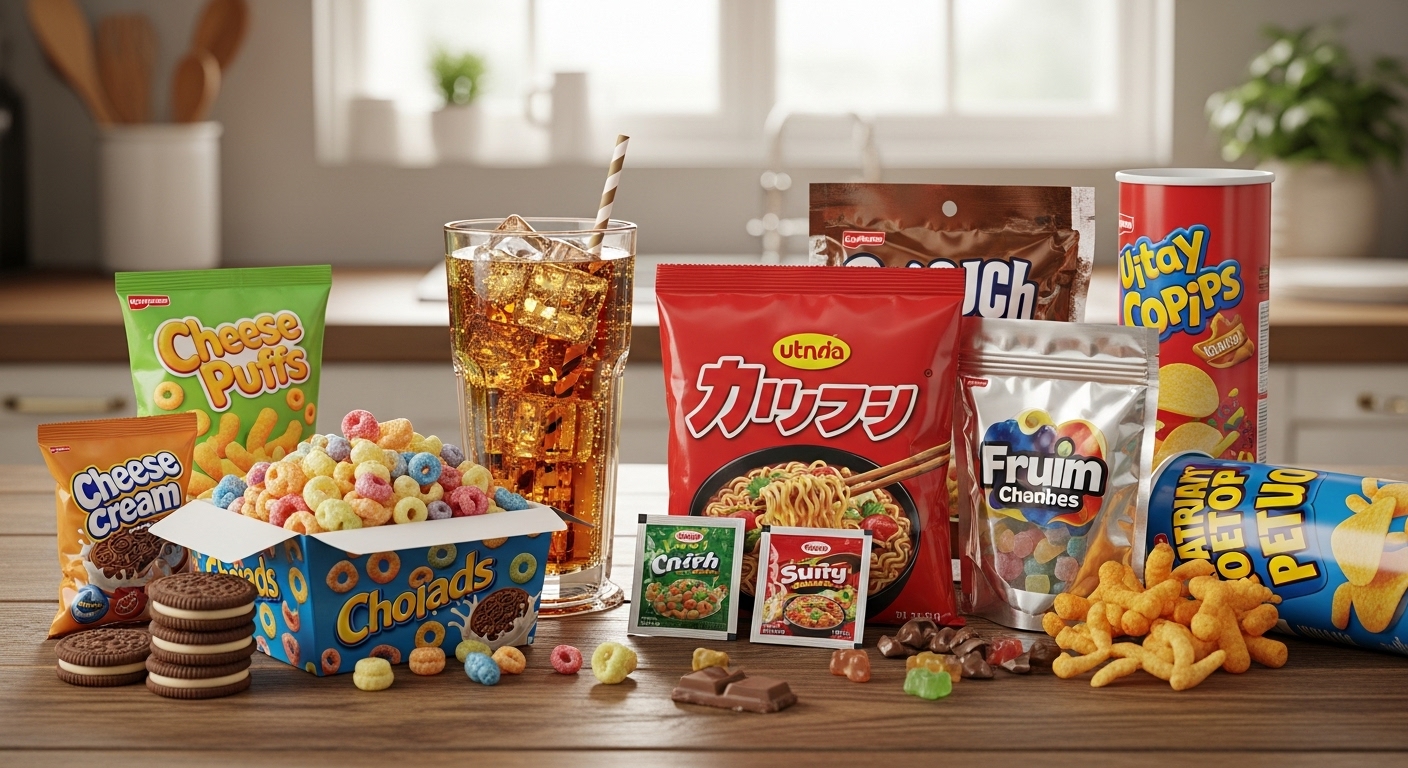
A landmark global review warns ultra-processed foods now dominate diets and are linked to chronic diseases. Learn what defines them, why scientists are calling for urgent policy action, and how you can shift your diet away.
1. Introduction
Imagine a world where more than half of what you and your family eat are foods not recognisable as meals, but rather highly processed industrial products. That scenario is increasingly our reality. On November 18, 2025, global researchers published a major review in The Lancet, warning that ultra-processed foods (UPFs) are now foundational to diets across many nations—and that the consequences for health, equity and planetary wellbeing are profound. The Lancet+1
This blog dives into what these foods are, why they matter, what the evidence says, and crucially, what both policy-makers and everyday people can do to shift away from this trend before it escalates further.
2. What Are Ultra-Processed Foods (UPFs)?
UPFs are foods made mostly or entirely from industrially formulated ingredients, often containing little or no whole food content, and designed to be convenient, hyper-palatable, shelf-stable and marketed aggressively.
According to the NOVA classification developed by Brazilian nutrition scientist Carlos Augusto Monteiro, UPFs fall into “Group 4” – the highest level of processing. Wikipedia+1
Examples include soft drinks, packaged snacks, instant noodles, re-formed meats, sugary cereals, and ready-to-heat meals.
Key characteristics of UPFs:
- Multiple ingredients not used in home cooking (e.g., emulsifiers, artificial sweeteners)
- Designed for convenience and profit
- Often displace fresh or minimally processed foods in the diet
3. The Evidence: Global Review & What It Shows
A series of three papers published in The Lancet by 43 international experts offers a sobering conclusion: UPFs are linked to declining diet quality and rising chronic disease risk—and global consumption is surging. The Guardian+1
Highlights:
- A review of 104 long-term studies found 92 reported higher risk of one or more chronic diseases with UPF intake. The Guardian
- In the U.S. and U.K., UPFs now represent more than half of all calories consumed. Gulf News
- The authors argue the evidence is strong enough to justify immediate public health action—not waiting for “perfect” proof. The Lancet
These findings are prompting health scientists to treat UPFs as a global public-health threat—some comparing the scale and urgency to what tobacco regulation faced decades ago.
4. How Extensive Is the Problem?
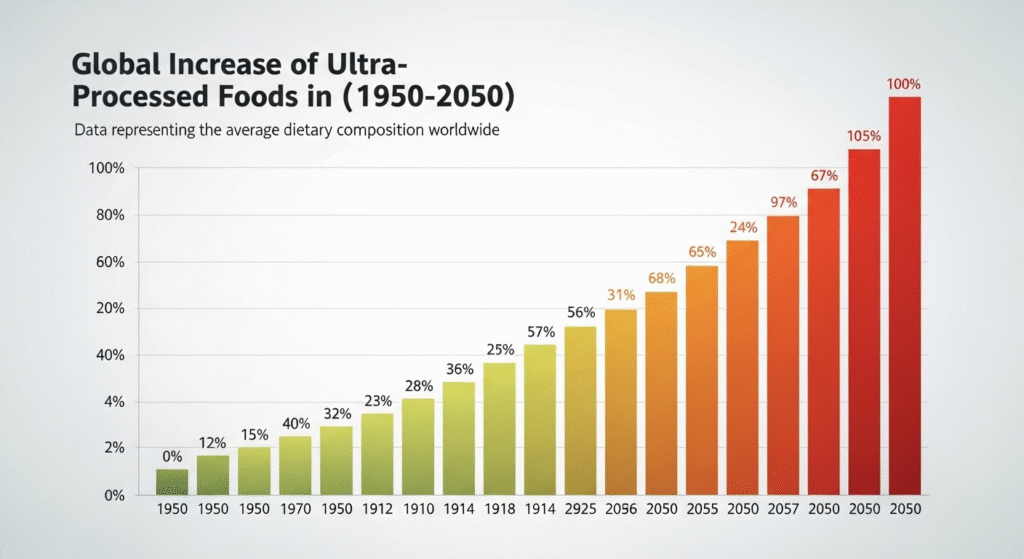
The scale of UPF consumption is startling.
- In Spain over the past 30 years, the share of UPFs in the diet climbed from 11% to 32%. SciTechDaily
- In China it rose from 4% to 10% in the same period.
- More than 600 million children worldwide are now classified as overweight or obese—linked to processed food intake. Food & Wine
In lower-income nations, as food systems industrialise, UPFs replace traditional whole-food diets fastest—creating a dual burden of malnutrition (undernutrition + overweight) in the same population.
5. Why UPFs Are So Pervasive
Several factors drive the rise of UPFs:
A. Corporate Power & Marketing
A handful of global firms dominate the sector, controlling vast processing capacity and advertising budgets. Gulf News
B. Convenience & Affordability
UPFs are engineered to be cheap, quick to prepare, hyper-palatable and long-shelf-life—aligned with busy modern lifestyles and tight budgets.
C. Food Environment & Policy Gaps
Many food environments, especially in low-income and transitional societies, prioritise access and cost over freshness and quality. Scientific authors warn this is a system driven by profit rather than health. The Guardian
D. Displacing Traditional Diets
UPFs don’t just add to diets—they often replace fresh and minimally processed foods, thus reducing overall nutritional value.
6. Health Consequences Linked to UPFs
The health literature on UPFs is mounting—and worrying.
- Diets high in UPFs have been statistically linked to increased risk of obesity, type 2 diabetes, cardiovascular disease, depression, and early mortality. The Guardian+1
- A UNICEF-led study found for the first time globally, more children aged 5–19 are obese (9.4%) than underweight (9.2%), a shift attributed in part to UPF dominance. The Guardian
- Some studies suggest UPF intake is associated with increased calorie consumption—even when macronutrients (sugar, fat) are matched, hinting at how processing influences over-eating. The Washington Post
While causality is still being studied, the associations are strong enough that scientists call for urgent action rather than wait for absolute confirmation.
7. Policy Responses: What Scientists Are Urging
Given the evidence, researchers are calling for global policy measures akin to those used against tobacco.
Suggested interventions include:
- Front-of-package warning labels for ultra-processed foods. The Guardian
- Marketing restrictions, especially targeting children (television, digital adverts).
- Fiscal measures, such as taxes on select UPFs, and subsidies for fresh food. Gulf News
- Restrictions in public institutions (schools, hospitals) against selling UPFs.
- Strengthened food-system regulation to reduce corporate influence and increase transparency.
Notably, Brazil’s school-food programme eliminated most UPFs and aims for 90% fresh / minimally processed foods in schools by 2026. SciTechDaily
The authors stress: individual behaviour change is not enough; systemic food-environment change is required.

8. What Individuals Can Do: Practical Dietary Shifts
You don’t have to wait for government action—here’s what you can do now:
- Increase whole foods: vegetables, legumes, fruit, whole grains, minimally processed meats/fish.
- Read labels: if a food has many unfamiliar ingredients (emulsifiers, artificial colours, flavouring agents), it may be ultra-processed.
- Limit ready-to-eat, pre-packaged meals: prepare more meals from scratch.
- Choose minimally processed alternatives: for example, choose plain yogurt rather than “flavoured and re-formulated” yogurts with additives.
- Plan your food environment: keep fresh produce visible, avoid buying many processed snacks.
- Educate children: talk about how the food industry works, and involve kids in meal planning and cooking.
9. Challenges & Criticisms
It isn’t all straightforward: The concept of UPFs and the NOVA classification system are subject to debate.
- Some critics argue the definition is too broad or vague, and that not all UPFs are nutritionally equal. The Guardian
- There’s limited long-term clinical trial data proving causation.
- Some argue focusing only on UPFs may distract from issues like overall calorie intake, sugar/fat/salt content, food security and affordability.
Scientists themselves admit gaps in research—but emphasise that delaying action is risky given the scale of the problem. The Lancet
10. Future Outlook: Food Systems and Global Health
The global conversation is shifting: UPFs are no longer an “individual choice” problem—they are a food-system issue. As processed-food companies expand into developing markets, the health impacts and equity implications become more acute.
Future directions may include:
- Global regulatory frameworks for UPFs
- Integration of food-processing considerations into dietary guidelines
- Innovation in reformulation—but many researchers argue reformulation alone isn’t enough
- Greater transparency and reduced corporate lobbying in nutrition science
- Better access to affordable fresh foods in lower-income regions
If global consumption of UPFs continues unchecked, the health, economic and social costs could be immense.

11. Conclusion
Ultra-processed foods are no longer a fringe concern—they are now central to the health of populations worldwide. The evidence is mounting, the trends are clear, and scientists across continents are calling for immediate change. While policy-level action is vital, individuals also have power: choosing fresh over packaged, reading labels, and reshaping food environments matter.
If we hope for a healthier future, the shift away from ultra-processing is not optional—it is urgent.
#UltraProcessedFoods #UPF #FoodPolicy #HealthNutrition #ProcessedFoodRisks #GlobalHealth #NOVAclassification #WholeFoodsMovement #DietShift #FoodSystems
12. Frequently Asked Questions (FAQs)
Q1. What counts as an ultra-processed food (UPF)?
A1. Foods that are industrially formulated with multiple ingredients not used in home cooking—like emulsifiers, artificial colours, flavourings, and many additives—and designed for convenience, shelf-stability and profit.
Q2. Are UPFs really linked to chronic disease?
A2. Yes—large reviews (e.g., The Lancet series) show strong associations between UPF consumption and obesity, diabetes, cardiovascular disease, depression and early mortality. The Guardian
Q3. How much of our diet is made up of UPFs?
A3. In many high-income countries (U.S., U.K., Australia) UPFs now contribute more than 50% of total calorie intake. Gulf News
Q4. What policies are being proposed to reduce UPF consumption?
A4. Warning labels, taxes on UPFs, restrictions on marketing (especially to children), banning UPFs in schools/hospitals, promoting whole-food diets.
Q5. Can I still eat some UPFs and be healthy?
A5. Yes—moderation helps. The key insight: UPFs should not displace fresh or minimally processed foods. Balance matters.
Q6. What is the NOVA classification?
A6. A system developed by Brazilian nutrition scientist Carlos A. Monteiro grouping foods by processing level (1: unprocessed, 2: culinary ingredients, 3: processed, 4: ultra-processed). Wikipedia